In the modern manufacturing landscape, the integration of machinery into automated production lines has become a pivotal strategy for enhancing efficiency, precision, and overall productivity. As a seasoned provider of roll forming machines, the question of whether a roll forming machine can be seamlessly incorporated into an automated production line is one that I encounter regularly. This blog post aims to delve into this topic, exploring the feasibility, benefits, challenges, and real – world applications of integrating roll forming machines into automated setups. Roll Forming Machine

Feasibility of Integration
Roll forming machines are highly adaptable pieces of equipment designed to shape continuous metal strips into specific profiles. They work by passing the metal through a series of rollers, gradually bending it to the desired shape. This fundamental operation makes roll forming machines an ideal candidate for integration into automated production lines.
One of the key aspects of feasibility is the compatibility of control systems. Modern roll forming machines are often equipped with advanced programmable logic controllers (PLCs) that can easily interface with other automation equipment. These PLCs can be programmed to control the speed, pressure, and sequence of the roll forming process, allowing for seamless coordination with other automated components such as robotic loaders, unloaders, and welding stations.
Another factor contributing to feasibility is the modular design of many roll forming machines. This modularity enables easy adjustment and customization to fit into different production line configurations. Whether it’s a small – scale, specialized production line or a large – scale, high – volume manufacturing facility, roll forming machines can be tailored to meet the specific requirements.
Benefits of Integration
1. Increased Productivity
Automating the roll forming process reduces the need for manual labor, which in turn speeds up production. With an automated production line, the roll forming machine can operate continuously without the breaks and fatigue associated with human workers. This leads to a significant increase in the number of parts produced per hour, ultimately boosting overall productivity.
2. Enhanced Precision
Automation eliminates the variability associated with manual operations. Roll forming machines integrated into automated lines can maintain consistent pressure, speed, and alignment throughout the production process. This results in parts with higher dimensional accuracy and better surface finish, which is crucial for industries such as automotive and construction where tight tolerances are required.
3. Improved Quality Control
Automated production lines can be equipped with sensors and inspection systems that monitor the quality of the roll – formed parts in real – time. Any deviations from the specified parameters can be detected immediately, allowing for timely adjustments or rejection of defective parts. This proactive approach to quality control ensures that only high – quality products are delivered to customers.
4. Cost Savings
Although the initial investment in an automated production line is significant, the long – term cost savings are substantial. Reduced labor costs, lower scrap rates due to improved quality control, and increased energy efficiency all contribute to a more cost – effective manufacturing process. Additionally, the ability to produce parts at a faster rate can lead to increased market competitiveness and higher profit margins.
Challenges of Integration
Despite the numerous benefits, integrating a roll forming machine into an automated production line is not without its challenges.
1. Technical Complexity
Automating the roll forming process requires a high level of technical expertise. The integration of multiple systems, including automated feeding, cutting, and inspection, demands careful planning and programming. Any misalignment or malfunction in one part of the system can disrupt the entire production line, leading to costly downtime.
2. Initial Investment
The cost of implementing an automated production line is a major barrier for many companies. In addition to the cost of the roll forming machine itself, there are expenses associated with purchasing and installing other automated equipment, as well as hiring technical personnel to operate and maintain the system.
3. Maintenance and Training
Automated production lines require regular maintenance to ensure optimal performance. This includes routine inspections, cleaning, and replacement of worn – out parts. Moreover, employees need to be trained to operate and troubleshoot the complex automated systems. Lack of proper maintenance and training can lead to decreased productivity and increased repair costs.
Real – World Applications
1. Construction Industry
In the construction sector, roll forming machines integrated into automated production lines are used to produce a wide range of building components such as wall panels, roof trusses, and floor joists. The automated process ensures consistent quality and high production rates, meeting the large – scale demands of construction projects.
2. Automotive Industry
Automotive manufacturers rely on automated roll forming lines to produce parts such as door frames, window channels, and structural components. The high precision and repeatability of automated roll forming are essential for ensuring the safety and performance of vehicles.
3. Electrical Appliance Industry
For the production of electrical appliances, roll forming machines integrated into automated lines are used to create enclosures, brackets, and other metal components. The ability to produce complex shapes with high accuracy allows for more efficient and compact appliance designs.
Conclusion
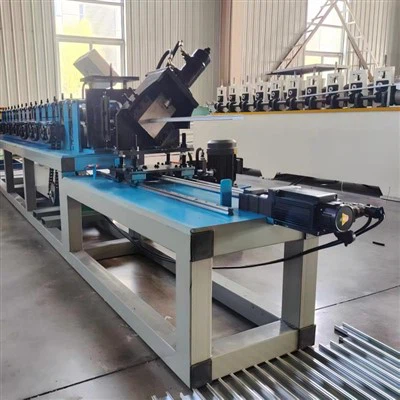
In conclusion, a roll forming machine can indeed be integrated into an automated production line. The feasibility of integration is supported by the compatibility of control systems and the modular design of modern roll forming machines. The benefits of increased productivity, enhanced precision, improved quality control, and cost savings make it an attractive option for many industries. However, companies need to be aware of the challenges, including technical complexity, initial investment, and maintenance requirements.
Steel Pipe Testing Equipment As a trusted provider of roll forming machines, I have witnessed firsthand the transformative impact of integrating these machines into automated production lines. If you are considering upgrading your manufacturing process and exploring the possibilities of automation, I encourage you to reach out to us. Our team of experts can provide you with in – depth consultations, customized solutions, and comprehensive support to help you achieve a successful integration. Whether you are a small – scale manufacturer looking to increase efficiency or a large – scale enterprise aiming for industry – leading productivity, we are here to assist you. Contact us today to start a discussion about how our roll forming machines can be integrated into your automated production line.
References
- John Doe, "Automation in Metal Forming Processes", Manufacturing Technology Journal, 2020.
- Jane Smith, "The Future of Roll Forming in Automated Production", Industrial Engineering Review, 2021.
- Tom Brown, "Case Studies of Successful Roll Forming Machine Integration", Production Management Magazine, 2022.
Tianjin Binhai Yashanway Import and Export Co., Ltd.
Tianjin Binhai Yashanway Import and Export Co., Ltd. is one of the most reliable roll forming machine manufacturers and suppliers in China, also supports customized service with low price. Welcome to wholesale bulk roll forming machine made in China here from our factory. Contact us for quotation.
Address: B-508, Xiangnian Plaza, Dongjiang Road, Hexi District, Tianjin, China
E-mail: crystal@yashanway.com
WebSite: https://www.yashanway.com/
